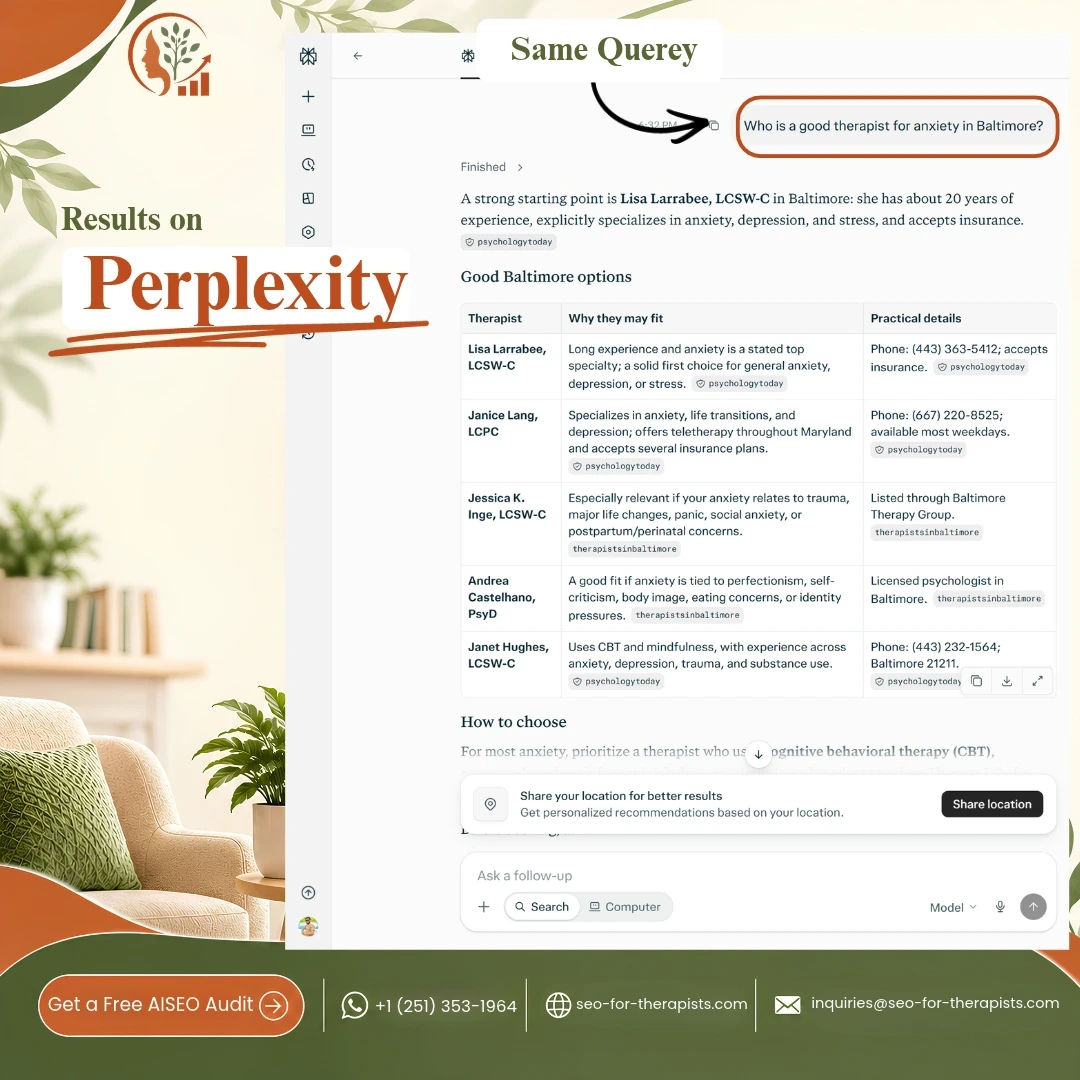
People now ask AI tools full questions like “who is a good psychologist for anxiety near me?” and “how do I choose between a psychologist and a counselor?”, so your website has to answer those above the layer questions in plain language.
AI visibility is a chain: crawling, indexing, retrieval, source selection and answer generation. Being indexed does not guarantee a recommendation.
Google says AI Overviews and AI Mode use established SEO practices, with no special AI optimization or special schema required.
Now you can claim your practice in ChatGPT just like GBP and feed it with updated data to influence AI visibility.
Create a separate page only when a topic has its own search intent, enough original information and a service you genuinely offer.
Lead each page with a short, clear answer on top, then add depth: who the service is for, what to expect, your qualifications and how to book.
Measure search performance, real enquiries and AI mentions separately, and treat AI checks as directional, not as a ranking report.
In our own client work, a solo psychologist went from no AI recommendations to being recommended for 7 of our 20 target prompts in six months. This is one practice, and results will vary.
What Actually We Did for This Practice to Show up in AI
We wrote this guide, ‘How do Therapists show up in AI search,’ around a real project, so everything below shows what we actually did and saw, not theory. The client is a solo clinical psychologist we will call Dr. A. She has 9 years of experience, sees adults aged 25 to 45 for anxiety, depression, trauma and couples work, and offers in-person and online sessions in a mid-sized US city. Her practice ran entirely on referrals.
She used her website just as a proof/resource for the clients. When people asked AI chatbots like ChatGPT or Gemini for a psychologist near them, competitors and directories were recommended and her name never came up.
The issue was not her expertise. Search engines and AI tools could not clearly see who she was, what she treated and why she could be trusted. Over six months we worked on AI Search Engine Optimization. You can read the full case study for the complete timeline.
Strategy #1: How Therapists show up in AI search
AI search visibility is not a single ranking factor. It is the end of a chain, and a practice can fall out of the chain at any link.
Crawling: automated bots fetch pages from your site.
Indexing: the system stores and processes what it found.
Retrieval: when someone asks a question, the system looks for candidate pages and sources, sometimes by running several related searches.
Source selection: the system chooses which sources to rely on or cite.
Answer generation: the tool writes a response, often with links.
Being indexed in Google does not guarantee a citation, and ranking well in traditional search does not guarantee a recommendation in an AI answer.
LLM Platform-Wise AI Visibility Factors for Therapists:
Google AI Overviews and AI Mode build on Google’s existing search systems. Google says both may use a technique called query fan-out, which issues multiple related searches to build a broader answer. A page must be indexed and eligible to show with a snippet to appear as a supporting link. Google also says no special AI optimization or special structured data is required beyond established SEO practices. One of those practices includes providing complete topical coverage around your niche you want to be cited for.
ChatGPT search uses OpenAI’s own crawler, OAI-SearchBot, to surface sites in its search features. We cover how to control it in section 6.
Perplexity and other answer engines retrieve live web sources and show citations, but each uses its own independent search index with its own crawling and ranking system.
What is documented and what is our judgment are different things. Crawl access, indexing and the platform controls above are documented by Google and OpenAI. Our recommendations about page structure, content and credibility come from our client work and how search works. These count as the best practices to get your practice cited in the AI, not a rule of thumb. Feel free to get an AI SEO Assessment to know what you’d exactly need in your case.
Hot Tip Most Therapists Miss for Ranking in ChatGPT:
Claim Therapy Business in ChatGPT:
OpenAI has just launched Businesses in ChatGPT, which means you can now claim your therapy practice inside ChatGPT through Business Hub, much like claiming a Google Business Profile. Once your practice is claimed and verified, you can update your key details directly instead of hoping ChatGPT pieces them together correctly from random pages online, and you can see real insight into how people encounter your practice there, including how often it gets mentioned, how many clicks your website receives, and which topics lead people to you.
This matters because an unclaimed practice is still being described by ChatGPT, just without your control, from whatever your website, directories, and reviews happen to say, right or wrong. The feature is still in beta and still rolling out to more categories and markets, which is exactly why it is an advantage right now: almost no therapy practice has claimed its listing yet, so the practices that move first will be the ones ChatGPT describes accurately, while everyone else keeps getting summarized from scraps.
AI SEO Assessment! What We Analyze Initially: We wrote down the questions real clients ask and ran them across tools for historical data analysis. Her practice was not recommended by any AI platform for any of our target prompts, and her main keywords sat on pages 3 and 4 of Google. That was our baseline. That is why good AI search optimization looks a lot like good SEO(Google verified), applied carefully to a therapy practice.
Strategy#2: Understand How Potential Clients Search
This section is about the search intent, not page building. Clients still use Google, and many now also ask AI tools in full sentences. These questions tend to include the situation, the symptoms, practical limits (telehealth, evenings, insurance) and the decision the person is weighing.
It helps to think of the prospect’s behavioural journey in three stages of intent: 1. Top of the Funnel (TOFU) – seeking purely informational content 2. Middle of the Funnel (MOFU) – exploring, comparing and analyzing different options 3. Bottom of the Funnel (BOFU) – Making a decision
Stage
What the person is asking
Example
Understanding the problem
What is happening to me?
“Why does my heart race when I think about work?”
Exploring approaches
What helps?
“What is CBT for anxiety and who is it for?”
Ready to choose
Who can I see?
“Who is a good psychologist for anxiety near me?”
What We did for Dr. A: We ran AI prompt research. We listed the questions real clients ask AI assistants before booking, including “who is a good psychologist for anxiety near me,” “how do I choose between a psychologist and a counselor” and “what happens in a first therapy session.” We then mapped each prompt/topic to a dedicated page that answers it directly, so no important question was left without a home on her site.
Spoiler: You do not need special tools to start. Review the questions that come up in consultation calls, intake forms and team discussions, and remove anything identifying.
Strategy#3: Build a Website that Clearly Explains Your Practice
This section is about site structure. When we audited Dr. A.’s practice, we found eight gaps. None of them are unusual for a therapy/psychology practice that has relied on referrals.
Gap
What we found
What we did
Website
One generic services page, no dedicated condition pages
Replaced it with dedicated pages for each specialty, such as anxiety therapy, trauma therapy and couples therapy
Search visibility
Primary keywords on pages 3 to 4
On-page optimization and keyword and query mapping
AI visibility
Not recommended by any AI platform for any target prompt
AI prompt research and monthly tracking
Content
Nothing that answered real client questions
Answer-first pages and original FAQs
Authority signals
No clinician bio, credentials or reviewed-by details
Added E-E-A-T elements to key pages
Structured data
No schema for the practice, services or FAQs
Implemented schema markup
Google Business Profile
Incomplete categories, 9 reviews
Optimized the profile and continued review generation
Backlinks and citations
Inconsistent listings, few trusted mentions
Citation cleanup, local citations and backlink outreach
The lesson for your own site is not “build a page for everything.” Use the gaps to decide what is missing. A separate page makes sense only when all three tests are true:
Distinct intent: people search for it differently from your other topics.
Enough original information: you can say something genuinely useful that would not fit on an existing page.
A unique service for a unique location: you actually offer it and are qualified to offer it.
If a topic fails the tests, make it a section on a stronger page. Publishing many near-identical pages is a risk, not a shortcut. Google’s spam policies warn against generating many pages without added value for users, whether a person or a tool writes them.
Your homepage is a power source for authority and traffic. Connect every URL website wide to leave no open end. Use Internal Linking as a strategic tool for sharing traffic and building trust to each important page.
Two more habits keep the structure healthy. Link related pages together, so a visitor can move from an anxiety page to a trauma or couples page. And keep the site accurate: specialties, locations, telehealth availability, fees or insurance information where appropriate, and the clients you want to serve should all match what you do today.
Strategy#4: Write Content that Answers Real Client questions
This section is about the writing itself. Private Practices come under the Your Money Your Life (YMYL) industry, where Google has strict scrutiny towards your website content. Your website copy must follow those best practices to offer value-added content for the visitors. Our practical principle, not a proven ranking rule, is to reflect the questions, concerns and decisions clients actually face before they contact a therapist.
What we did for Dr. A. Each page opened with a short, plain-language answer to the main question, for example “What is CBT for anxiety and who is it for?”, followed by deeper detail. We chose this answer-first format because it is easier for people to read and for AI tools to extract. In month 3 we published answer-first articles and FAQs built from the prompt research in section 2.
Here is an illustrative before and after. This is an example, not Dr. A.’s actual copy.
Generic: “Anxiety is a common mental health condition characterized by excessive worry. I provide evidence-based therapy for adults.”
Specific: “If you replay conversations at 2 a.m. or feel your chest tighten before meetings, you are not alone. Anxiety can show up in your thoughts and your body. In a first consultation, we talk through what you are experiencing and whether my approach is a good fit.”
The second version describes recognizable moments without diagnosing the reader or promising an outcome. Keep that line clear. Describe experiences, not conclusions. Avoid promises such as “you will feel calm again.” And state clinical limits where relevant: a racing heart can have medical causes, so a good page also encourages talking to a physician.
FAQs that earn their place. Write answers to questions clients really ask, such as what happens in a first session, whether you offer telehealth and how you differ from a counselor. There is no magic number of questions, and padding a page to hit a count makes it worse.
Can Therapists Use AI to Write Website Content:
Using AI to help write. Google says generative AI can help with research and structure, and the risk is publishing many low-value pages. Start from your own clinical knowledge, use AI as a drafting aid, then review for accuracy, tone and ethics before anything goes live. If you want help turning clinical expertise into pages, our copywriting services for therapists are built for that.
Strategy#5: Strengthen Credibility Beyond Your Website
Be careful with this topic, as credibility is the supporting vote for AI visibility. Signals that help a visitor verify you are a qualified professional are not the same as factors proven to influence AI citations. We recommend them because clients, referral sources and search systems all benefit from clear, consistent, truthful information, not because any one item guarantees a mention.
As a Therapy Practice Owner, focus on:
Accurate credentials: license type, license number where appropriate, and states of practice. Dr. A.’s site had no clinician bio, credentials or reviewed-by details, so we added them and calimed both on-site & off-site.
Clear specialties and approaches: Above the Layer Content: what you treat, how & where you work and who you serve.
Consistent business details: the same practice name, address, phone number (NAP Consistency) and website everywhere they appear. We ran a citation cleanup in month 3 to fix her inconsistent listings.
A complete Google Business Profile and relevant professional directory listings, where your practice is eligible. Hers had incomplete categories and 9 reviews. Explore more for local ranking in Google Business Profile for therapists and local SEO for therapists.
A detailed About page and team information: Very important for AI bots. Who you are, your training and what you focus on.
Ethical third party recognition: associations, credible publications and relevant directories. Our backlink outreach began in month 4. Off-page SEO for therapists should be about earning genuine reputation, not generating mentions to influence AI systems.
Reviews need special care in mental health. Request them only in ways your licensing board and ethics code allow, and when you respond to a review, never confirm that someone was a client.
Strategy#6: Check the Website Technical Foundations
A page that cannot be crawled, indexed or read cannot be retrieved. Work through these checks in order:
Crawl access and indexing. Make sure important pages are not blocked by robots.txt or a noindex tag, and confirm in Google Search Console (GSC) that they are indexed. For Dr. A., we checked that robots.txt and security settings did not block AI crawlers such as OAI-SearchBot and PerplexityBot.
Readable text. Put key information in real page text, not only in images, scripts or PDFs. We confirmed her key content was in plain HTML.
Internal links, mobile and speed. Important pages should be easy to reach and load quickly on a phone. We checked that her pages loaded fast on mobile.
Schema where it fits. We implemented schema markup for her practice, the clinician, her services and FAQs so search engines and AI tools could understand the entity, location and specialties. Note that Google says no special schema is required for its AI features, so treat structured data as a clarity aid and make sure it matches what is visible on the page.
Skip unverified shortcuts. Google advises against spending effort on llms.txt files, artificial content chunking and AI specific rewriting. Our technical SEO for therapists work starts with crawling and indexing for this reason.
OAI-SearchBot versus GPTBot. OpenAI documents these as separate controls. OAI-SearchBot is used to surface sites in ChatGPT search, and OpenAI says sites that opt out of it will not be shown in ChatGPT search answers, though they may still appear as navigational links. GPTBot relates to crawling content that may be used to train OpenAI’s models. A site can allow one and block the other. OpenAI notes that robots.txt changes can take about 24 hours to take effect for search.
For example, a practice that wants ChatGPT search visibility but does not want its content used for training could use:
Whether to block GPTBot is your decision. Blocking OAI-SearchBot removes you from ChatGPT search answers. Check your current robots.txt before changing anything.
How to Measure AI Visibility for Therapists
AI visibility is only one part of your online performance. A useful measurement system should distinguish between early SEO signals, AI search observations, and actual business outcomes.
KPI
Measurement type
Recommended review
Indexed priority pages
Technical
Weekly
Keyword rankings and search impressions
Leading indicator
Monthly
Pages ranking in positions 5 to 20
Optimization opportunity
Monthly
Search click through rate
Leading indicator
Monthly
Practice mentions across tracked AI prompts
AI visibility indicator
Monthly
AI citations and linked sources
AI visibility indicator
Monthly
Relevant backlinks and external mentions
Authority indicator
Monthly
Organic enquiries and consultation requests
Business outcome
Monthly
Qualified leads and booked consultations
Business outcome
Monthly
Organic traffic and landing page conversions
Business outcome
Monthly
How to Track AI Search Visibility Consistently
AI answers can vary between sessions, locations, platforms, and the wording of a prompt. A single successful recommendation does not establish consistent visibility.
For more meaningful comparisons:
Use the same set of prompts throughout the measurement period.
Record the AI platform and testing date.
Track whether your practice is named, cited, or simply discussed as an option.
Save the response and source links where available.
Compare results over multiple testing periods instead of relying on one response.
For example, if your practice appears in seven out of 25 tracked prompts, record that as 7 out of 25 for that testing period. Repeat the process later to see whether visibility has changed.
Category
What to track
What it tells you
Traditional search performance
Search Console impressions, clicks, queries and indexed pages
Whether your pages are visible and being found
Business outcomes
Qualified enquiries, consultation bookings, calls and intake forms
Whether visibility becomes real conversations
AI visibility observations
Whether relevant queries/prompts surface the practice, which pages are cited, which third party sources appear. GSC (Generative AI) tracks your online property’s AI visibility as well. Track Website & social media through GSC and other tools.
Directional evidence only
How we tracked Dr. A. Each month we ran the same set of 20 target prompts on ChatGPT, Gemini, Perplexity and Claude, and logged the platform, the prompt, the date and whether the practice was recommended. We also tracked visits from AI platforms in Google Analytics as referral traffic.
AI answers vary by question, location, personalization and timing, so treat these checks as directional. Referral traffic from AI platforms may show up in analytics, but not every AI assisted enquiry will be identifiable, so add a “How did you hear about us?” question to your intake.
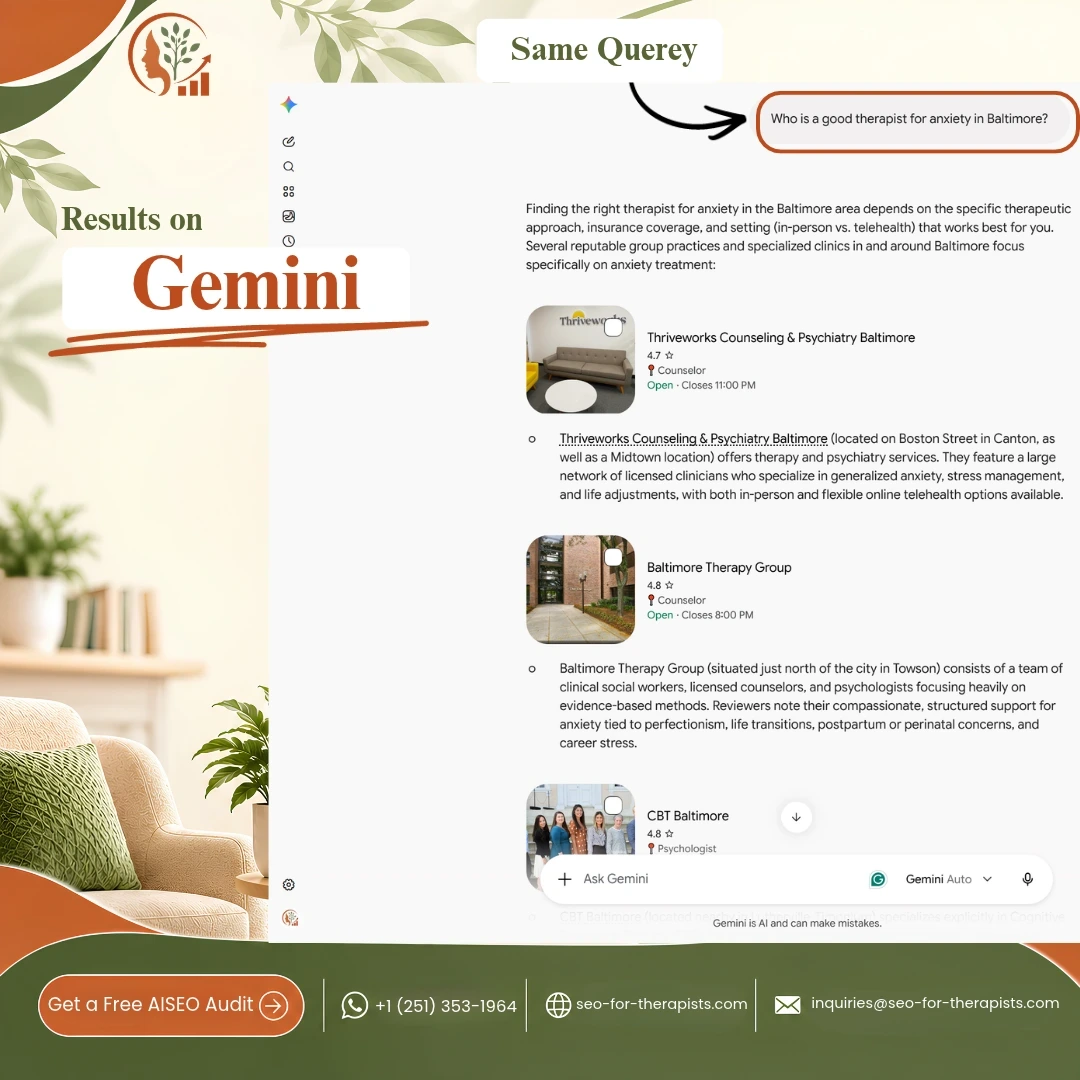
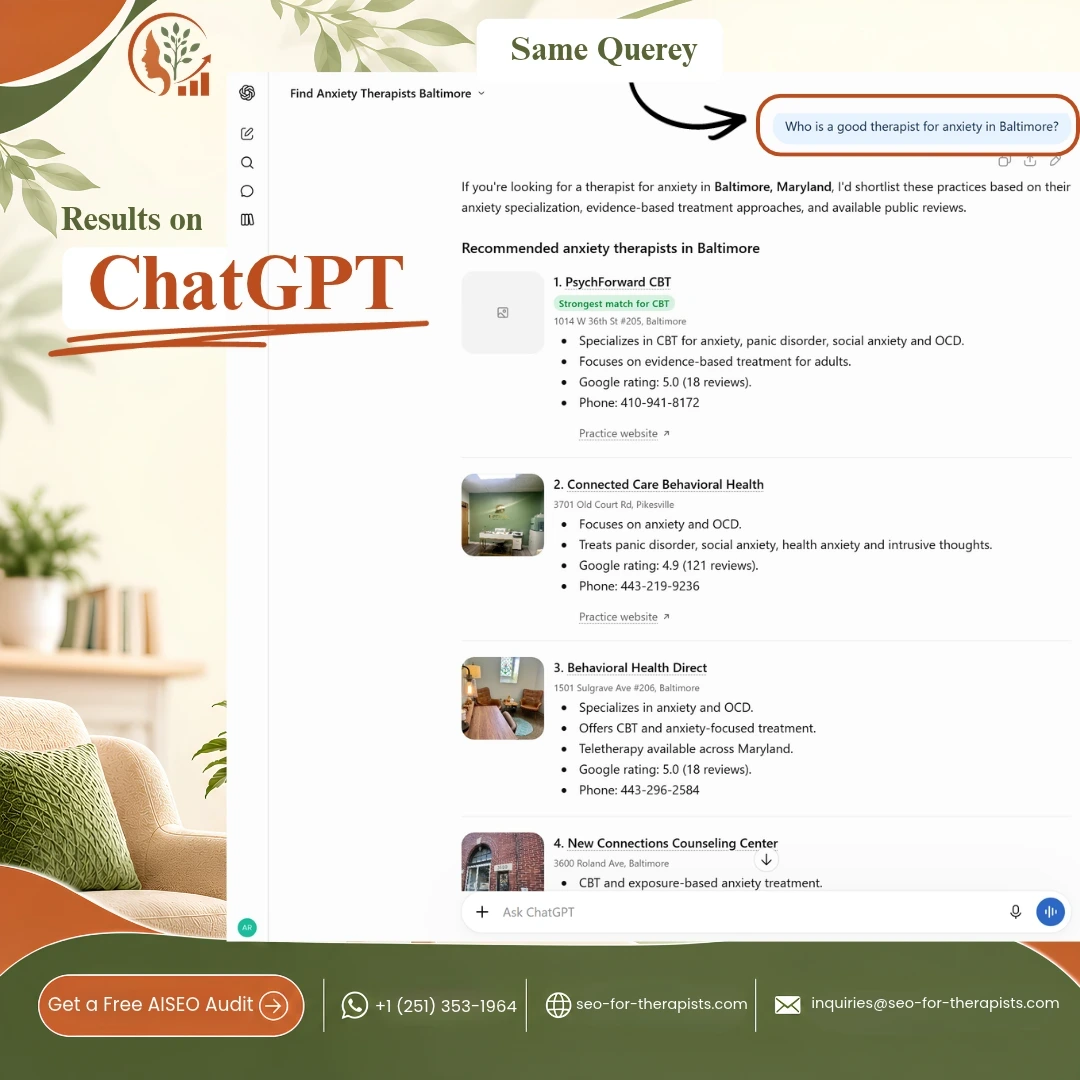
One of the first recommendations was ChatGPT answering “Who is a good psychologist for anxiety near me?”, which we saved as a screenshot in our campaign log.
How to read this honestly: this is one solo practice over six months. We did many things at once, so we cannot say which change caused which result, and we cannot promise the same outcome for another practice. What the case does show is that clearer pages, trustworthy details and crawlable content moved Google and AI results in the same direction.
With a steady flow of enquiries, Dr. A. no longer depended only on referrals and could be more selective about client fit.
The 90 Day AI Visibility Action Plan for Therapists
Improving your visibility in AI search is not about publishing more content or adding a few technical elements to your website. It requires a coordinated approach to your website, local search presence, content, and credibility across the web.
To understand how these efforts can come together, let’s first look at what happened when we worked with Dr. A. over six months.
What Six Months of SEO and AI Visibility Work Achieved
We worked on Dr. A.’s online presence through a series of improvements, building the technical foundation, strengthening important service pages, publishing relevant content, and improving the practice’s authority.
Month
Focus
Work completed and progress
1
Foundation
Conducted a full SEO and AI visibility audit, keyword and query mapping, competitor analysis, and Google Business Profile optimization.
2
Website structure
Rebuilt condition pages, improved on page SEO, and added relevant professional credibility information.
3
Content and relevance
Published answer focused articles and FAQs, implemented appropriate schema markup, and worked on citation consistency.
4
Authority
Began relevant backlink outreach, continued review management, and saw secondary keywords reach Google’s first page.
5
AI visibility
ChatGPT recommended the practice in response to the prompt: “Who is a good psychologist for anxiety near me?”
6
Consolidation
The practice appeared in responses to seven tracked AI prompts, primary keywords reached Google positions 3 to 6, and monthly enquiries increased to 23.
What this demonstrates: AI visibility was not the result of one isolated change. It developed alongside improvements to the practice’s website, search presence, content, and online credibility.
Note: The six month timeline reflects this particular project. Your own timeline will depend on your website’s starting condition, competition, location, and implementation capacity.
Proposed AI SEO Action Plan for Therapists
You do not need to rebuild your entire website to start improving your AI search visibility. Begin with the pages and technical issues that matter most, then strengthen your content and credibility systematically.
The following plan organizes the work into three stages. Some activities can run concurrently, depending on your website and available resources.
Days 1 to 30: Establish Your Baseline and Find the Gaps
Before making changes, understand how your practice currently performs in traditional search and AI search.
Priority
What to work on
What it involves
1. Establish your baseline
Record current performance
Document organic traffic, Google rankings, search impressions, click through rates, enquiries, and existing AI search mentions.
2. Audit your website
Identify technical barriers
Review indexability, crawl access, broken links, redirects, mobile usability, page speed, and important technical errors.
3. Map search intent
Understand what potential clients search for
Group relevant keywords and conversational questions by informational, comparison, and appointment seeking intent. Assign each topic to an appropriate page.
4. Test AI visibility
Build a prompt tracking sheet
Create a consistent set of 25 relevant prompts and test them across selected AI platforms. Record whether your practice is mentioned, cited, or absent.
5. Analyze competitors
Identify content and visibility gaps
Review the pages, specialties, local listings, and credible external sources that help competing practices become discoverable.
6. Review your online profiles
Check business information
Verify your Google Business Profile, website contact details, professional directories, location information, and practice descriptions.
Your deliverable by day 30: A documented baseline, prioritized technical issues, a keyword and question map, and a clear list of pages and visibility gaps to address.
Days 31 to 60: Strengthen Your Website and Content
Use the audit findings to improve the pages most closely connected to your services and ideal clients.
Priority
What to work on
What it involves
1. Resolve technical issues
Improve crawlability and usability
Fix priority indexing problems, broken internal links, redirect issues, and mobile or performance problems. Review relevant crawler access settings.
2. Improve priority service pages
Make your services easier to understand
Explain who each service is for, the concerns it addresses, your approach, professional qualifications, and how prospective clients can take the next step.
3. Build relevant content
Answer real client questions
Create useful content around common concerns, symptoms, treatment approaches, populations served, and questions people ask before contacting a therapist.
4. Improve internal linking
Connect related information
Link relevant articles, specialty pages, service pages, and location pages so visitors and search engines can understand how your content relates.
5. Implement appropriate schema
Clarify your website information
Use accurate structured data for your organization, practice, and clinicians where appropriate. Validate the implementation and avoid marking up information that is not visible or accurate.
6. Improve external consistency
Strengthen your practice information
Correct outdated directory listings and ensure your professional information is consistent across relevant platforms.
Your deliverable by day 60: Stronger authority on priority pages, improved technical foundations, useful supporting content, and a more consistent online presence.
Days 61 to 90: Build Credibility and Evaluate Progress
Once your most important pages and foundations are in place, focus on strengthening your practice’s presence beyond its website and measuring the progress made.
Priority
What to work on
What it involves
1. Build relevant authority
Earn credible external mentions
Identify relevant professional associations, reputable directories, local organizations, and publications that may provide legitimate opportunities for recognition and links.
2. Strengthen your local presence
Maintain accurate practice profiles
Keep your Google Business Profile updated, post regularly, maintain accurate service information, and respond to reviews appropriately within professional and privacy guidelines.
3. Expand useful content
Address remaining content gaps
Publish or improve content based on actual search demand, client questions, and competitor gaps. Prioritize usefulness and accuracy over publishing volume.
4. Recheck AI visibility
Repeat your prompt tests
Run the same prompts on the same platforms and record changes in practice mentions, citations, and recommendation context.
5. Review organic performance
Compare results with your baseline
Evaluate changes in rankings, impressions, clicks, organic traffic, and relevant landing page performance.
6. Evaluate enquiries
Connect visibility to business outcomes
Review qualified enquiries, consultation requests, calls, and bookings. Use appropriate tracking and intake questions to understand where prospective clients discovered your practice.
Your deliverable by day 90: A progress report showing what improved, what remains unresolved, which activities are producing useful signals, and what should be prioritized next.
Want a Second Opinion on Your Practice?
If you would like help finding where your service pages, local visibility and search strategy could improve, request a free SEO audit. If AI search is your main interest, you can also learn about AI search optimization for therapists.
FAQs for Therapists AI Visibility
How do therapists show up in ChatGPT search results?
ChatGPT search can surface sites its crawler can access, so the basics are allowing OAI-SearchBot, having clear, useful pages and having credible information about your practice available on the web. Influence GPT responses with updated data around your therapy practice by claiming Business in ChatGPT.
Can ChatGPT recommend my therapy practice?
It can, but no one can promise it will. In our case study, ChatGPT first recommended Dr. A. in month 5, after we had rebuilt her pages, fixed her business details and confirmed AI crawlers could read her site.
Does my therapy website need to rank on Google to appear in AI search?
Not necessarily for every tool, but for Google’s AI Overviews and AI Mode a page must be indexed and eligible to appear in Google Search with a snippet. Strong SEO foundations help across platforms, but ranking alone does not guarantee a citation.
How can I tell whether AI tools are mentioning my practice?
Run a consistent set of relevant prompts, record the platform, date and result, and repeat monthly. Also check your analytics for AI platform referrals and ask new clients how they found you. Treat all of this as directional.
Should therapists create separate pages for every specialty?
Only when the topic has distinct search intent, you have enough original information for it, and it is a service you genuinely offer. Otherwise, combine it into a stronger page.
Does schema markup help therapists appear in AI search?
Google says no special schema is required for its AI features. We implement it for clarity and make sure it matches what is visible on the page, but we do not treat it as a shortcut.
Can I use AI to write content for my therapy website?
Yes, as a drafting and structuring aid. Google’s concern is large volumes of pages that add no value. Build from your own clinical knowledge, review everything for accuracy and ethics, and avoid publishing pages just to cover keyword variations.
How long does it take to improve AI search visibility?
There is no reliable timeline. In our case study, the first AI recommendation came in month 5, but that depends on the site’s starting point, local competition and the work done. Be cautious of any provider who promises a specific timeframe or result.