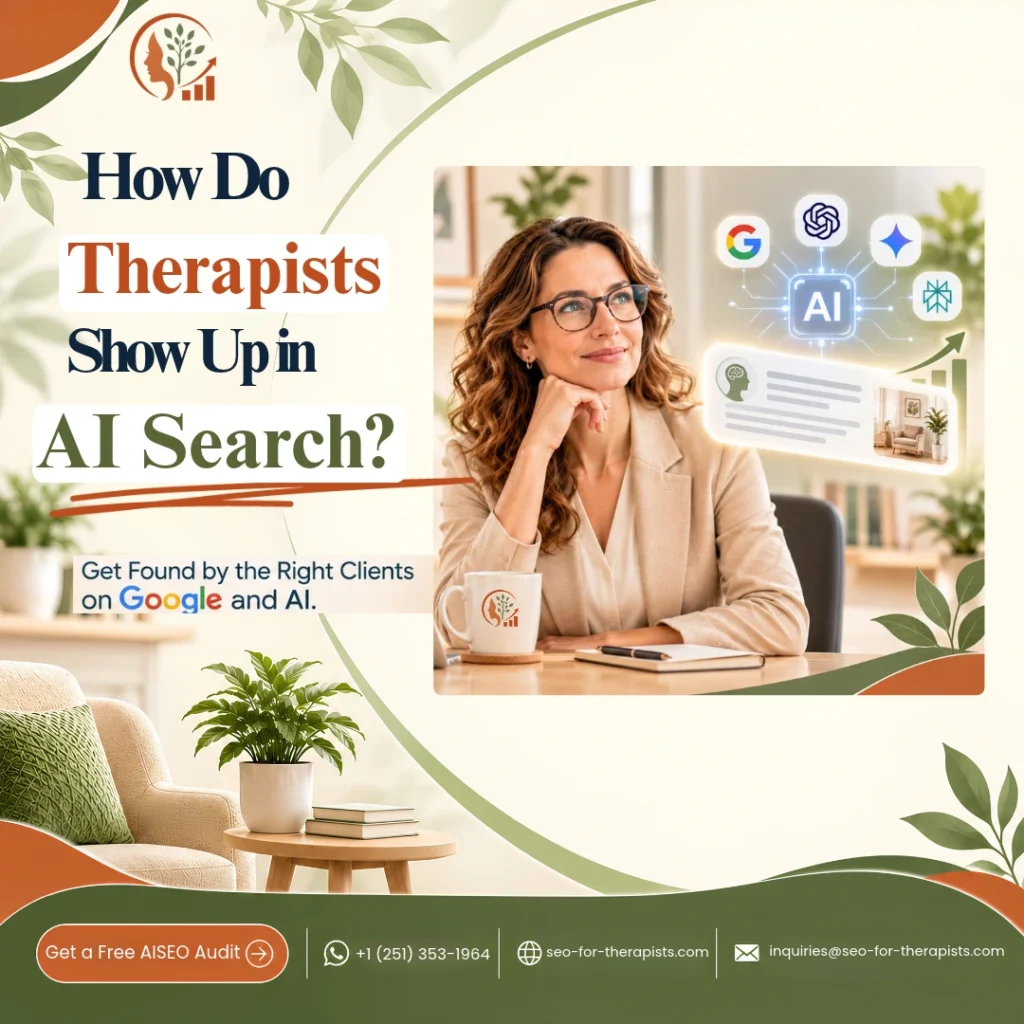
How do Therapists show up in AI Search?
AI Search Visibility How do Therapists show up in AI Search? by SEO for Therapists On November 13, 2026 Key Takeaways People now ask AI tools full questions like “who is a good psychologist for anxiety near me?” and “how do I choose between a psychologist and a counselor?”, so your website has to answer those above the layer questions in plain language. AI visibility is a chain: crawling, indexing, retrieval, source selection and answer generation. Being indexed does not guarantee a recommendation. Google says AI Overviews and AI Mode use established SEO practices, with no special AI optimization or special schema required. Now you can claim your practice in ChatGPT just like GBP and feed it with updated data to influence AI visibility. Create a separate page only when a topic has its own search intent, enough original information and a service you genuinely offer. Lead each page with a short, clear answer on top, then add depth: who the service is for, what to expect, your qualifications and how to book. Measure search performance, real enquiries and AI mentions separately, and treat AI checks as directional, not as a ranking report. In our own client work, a solo psychologist went from no AI recommendations to being recommended for 7 of our 20 target prompts in six months. This is one practice, and results will vary. What Actually We Did for This Practice to Show up in AI We wrote this guide, ‘How do Therapists show up in AI search,’ around a real project, so everything below shows what we actually did and saw, not theory. The client is a solo clinical psychologist we will call Dr. A. She has 9 years of experience, sees adults aged 25 to 45 for anxiety, depression, trauma and couples work, and offers in-person and online sessions in a mid-sized US city. Her practice ran entirely on referrals. She used her website just as a proof/resource for the clients. When people asked AI chatbots like ChatGPT or Gemini for a psychologist near them, competitors and directories were recommended and her name never came up. The issue was not her expertise. Search engines and AI tools could not clearly see who she was, what she treated and why she could be trusted. Over six months we worked on AI Search Engine Optimization. You can read the full case study for the complete timeline. Strategy #1: How Therapists show up in AI search AI search visibility is not a single ranking factor. It is the end of a chain, and a practice can fall out of the chain at any link. Crawling: automated bots fetch pages from your site. Indexing: the system stores and processes what it found. Retrieval: when someone asks a question, the system looks for candidate pages and sources, sometimes by running several related searches. Source selection: the system chooses which sources to rely on or cite. Answer generation: the tool writes a response, often with links. Being indexed in Google does not guarantee a citation, and ranking well in traditional search does not guarantee a recommendation in an AI answer. LLM Platform-Wise AI Visibility Factors for Therapists: Google AI Overviews and AI Mode build on Google’s existing search systems. Google says both may use a technique called query fan-out, which issues multiple related searches to build a broader answer. A page must be indexed and eligible to show with a snippet to appear as a supporting link. Google also says no special AI optimization or special structured data is required beyond established SEO practices. One of those practices includes providing complete topical coverage around your niche you want to be cited for. ChatGPT search uses OpenAI’s own crawler, OAI-SearchBot, to surface sites in its search features. We cover how to control it in section 6. Perplexity and other answer engines retrieve live web sources and show citations, but each uses its own independent search index with its own crawling and ranking system. What is documented and what is our judgment are different things. Crawl access, indexing and the platform controls above are documented by Google and OpenAI. Our recommendations about page structure, content and credibility come from our client work and how search works. These count as the best practices to get your practice cited in the AI, not a rule of thumb. Feel free to get an AI SEO Assessment to know what you’d exactly need in your case. Hot Tip Most Therapists Miss for Ranking in ChatGPT: Claim Therapy Business in ChatGPT: OpenAI has just launched Businesses in ChatGPT, which means you can now claim your therapy practice inside ChatGPT through Business Hub, much like claiming a Google Business Profile. Once your practice is claimed and verified, you can update your key details directly instead of hoping ChatGPT pieces them together correctly from random pages online, and you can see real insight into how people encounter your practice there, including how often it gets mentioned, how many clicks your website receives, and which topics lead people to you. This matters because an unclaimed practice is still being described by ChatGPT, just without your control, from whatever your website, directories, and reviews happen to say, right or wrong. The feature is still in beta and still rolling out to more categories and markets, which is exactly why it is an advantage right now: almost no therapy practice has claimed its listing yet, so the practices that move first will be the ones ChatGPT describes accurately, while everyone else keeps getting summarized from scraps. AI SEO Assessment! What We Analyze Initially: We wrote down the questions real clients ask and ran them across tools for historical data analysis. Her practice was not recommended by any AI platform for any of our target prompts, and her main keywords sat on pages 3 and 4 of Google. That was our baseline.That is why good AI search optimization looks a lot like good SEO(Google verified), applied carefully to a therapy practice. Strategy#2: Understand How