









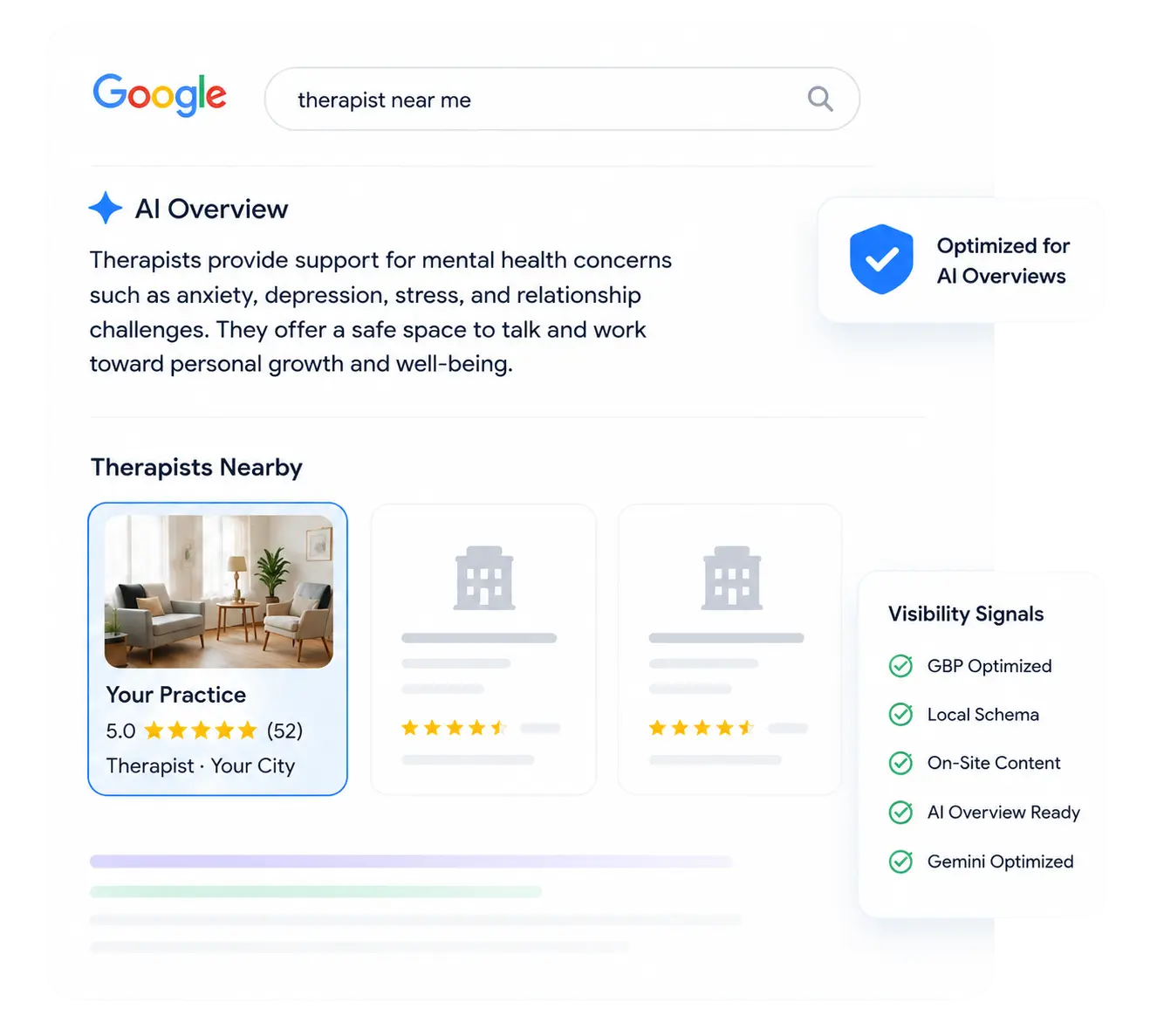

68% of Google searches in the U.S. now end without a click.
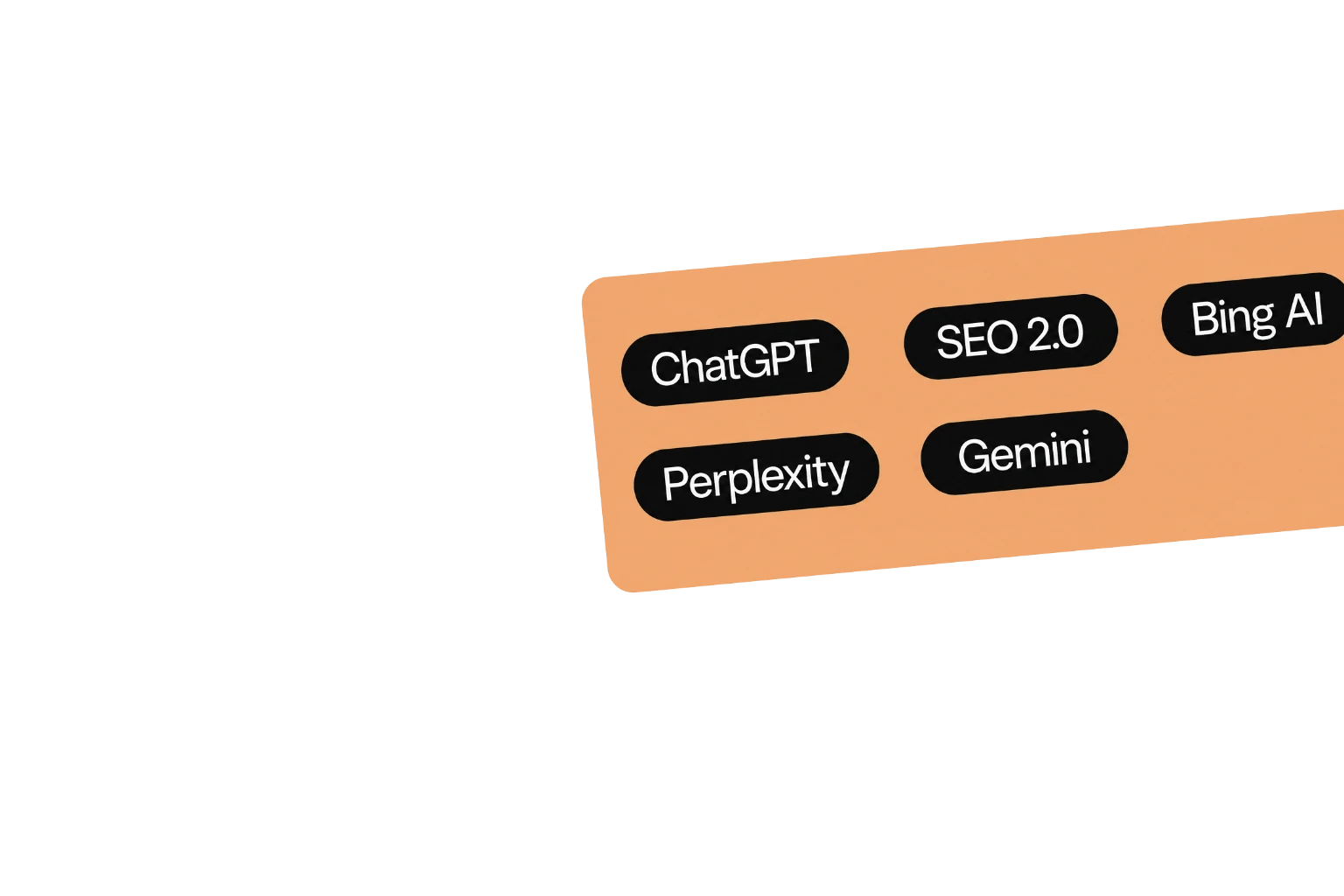
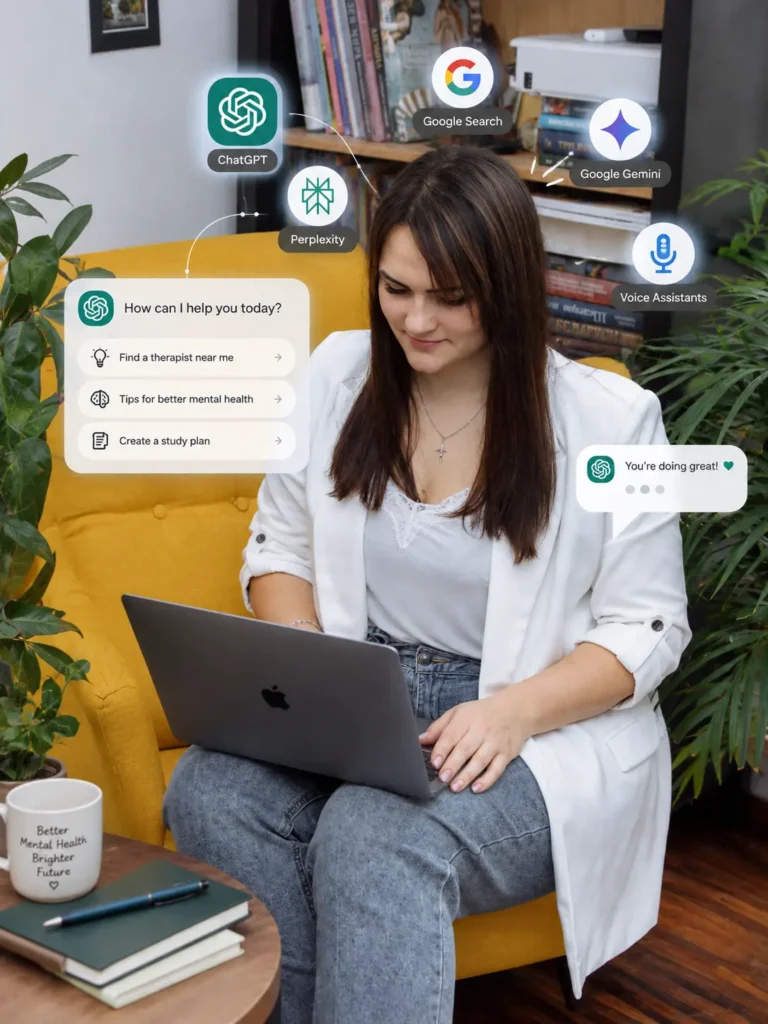
And more people are asking ChatGPT, Gemini, Perplexity, Copilot,
Siri, or Alexa to find, compare, and recommend therapy-related
questions or services.
Therapy businesses winning in those chats are solid in SEO
foundation with an additional layer of AI Search Optimization for therapists.
We optimize US therapy practices crystal clear to be
understood, Trusted, Cited, and Recommended by AI chats and Overviews.
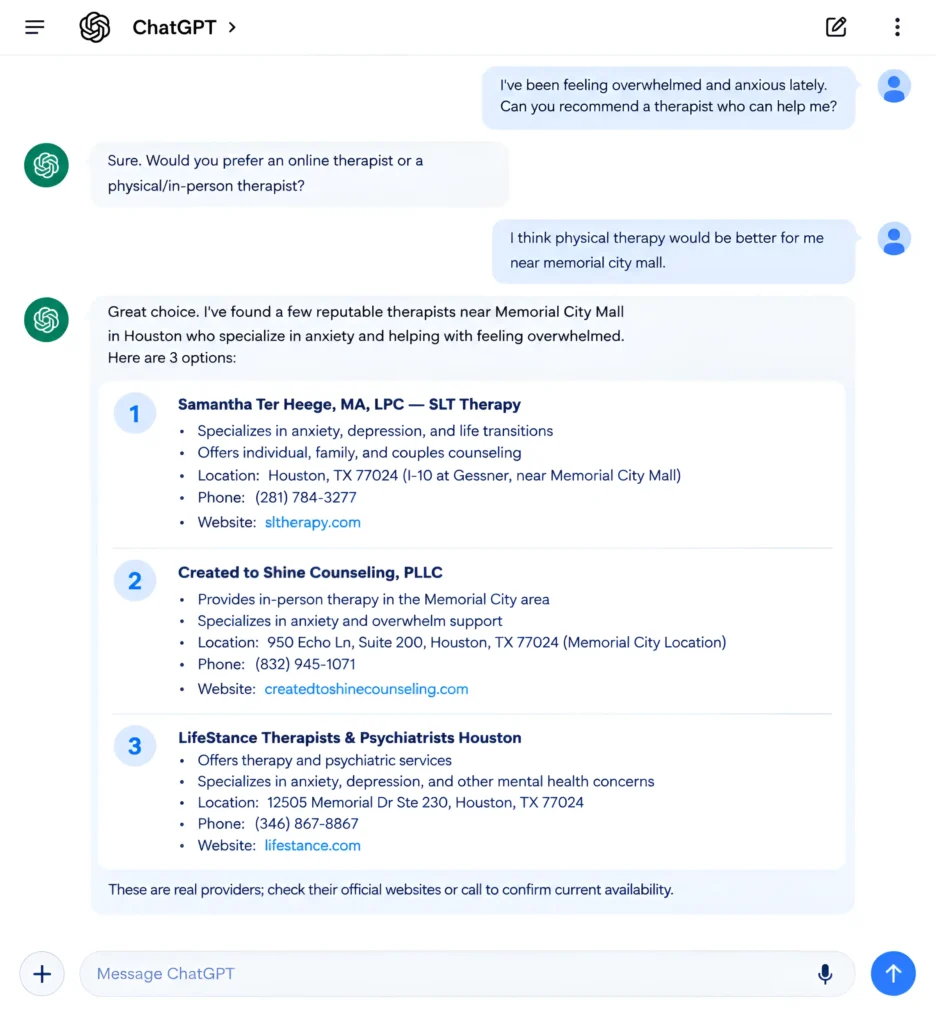
Search doesn’t look like it used to. A prospective client asking “who’s a good anxiety therapist near me who takes Aetna” increasingly gets one AI-written answer instead of ten blue links. And if your practice isn’t part of that answer, it’s as if you don’t EXIST to that person.
Free AI SEO Visibility Audit
AI Search Optimization is an additional layer of search optimization to ensure your practice’s information is accurate, structured, trustworthy, and authoritative enough that AI chats recommend as a top choice. Traditional SEO focuses more on 10 blue links on the first search results page, while AEO/GEO serves a critical role in direct citations of your clinic inside the AI-generated response.
Our AEO for therapists covers everything to help you show up as a top recommended choice wherever potential clients are searching for you online. In our AI SEO for therapists, we have acquired a strong grip on these two more specific disciplines:
Most agencies pick one acronym and sell it as the whole solution. We treat AI optimization services as one connected strategy for our partner therapists, so your practice builds AI visibility across every engine at once.
Audit your website for visibility in ChatGPT, Gemini, Copilot and Perplexity to uncover AI discoverability gaps and understand how your practice currently appears in AI search.
Compare your AI visibility and citations with competing therapists and practices in your area to map positioning mismatch and growth paths.
Build relevant brand mentions and practice citations across authoritative sources that AI systems use to understand credibility, expertise, and relevance.
Map your website content to search intent so AI models can recognize your services, specialties, locations, and expertise as accurate and context-rich sources.
Discover how potential clients phrase questions on ChatGPT, Gemini, Siri, and Bing AI, then identify the conversational patterns relevant to your therapy services.
Structure and refine your website content for ChatGPT using intent-based queries, clear Above the Fold answers, and AI-friendly formatting that makes your expertise easier to understand.
Track your practice's brand mentions, citations, and answers across AI engines to measure visibility and identify opportunities for improvement.
Implement therapy business schema for services, specialties, FAQs, location, reviews, and entities to help AI engines interpret your practice, services, and content and surface relevant answers accurately.
Create new structured content and optimize the existing content for AI engines that provides clear answers, relevant evidence, and supporting context around the questions your potential clients are asking.
Plan a roadmap that combines technical SEO, entity consistency, and content to build stronger AI visibility for your therapy practice.
Analyze AI-generated citations of your practice and identify the authority signals and source credibility needed to strengthen your visibility across AI search.
Adapt your content for conversational and voice-driven AI queries to improve discovery when potential clients search using natural conversational language.
People ask a
health question
Answer engines
provide one
direct answer
They cite the most
relevant, helpful
content
Answer engines (Perplexity, Google AI Overviews, voice assistants, and increasingly ChatGPT's direct-answer mode) don't return a blue link list like traditional Google.
They return one tightly written answer, usually pulled from a short, self-contained passage that directly matches the health question asked.
For a therapy practice, that means content built in an answer-first query fan-out method in question-and-answer blocks.
Turn the questions your clients ask into clear, useful content that helps AI understand and recommend your practice.
GEO is a different problem: it’s not about winning a single direct answer; it’s about how your practice gets described when someone asks a broader question. For example, “What should I look for in a good trauma therapist” or “How does EMDR compare to talk therapy”. And the AI weaves a recommendation into a longer, generated response.
This is where brand consistency, entity understanding, and topical authority matter most. If your practice’s name, specialties, and credentials appear the same way across your website, Google Business Profile, and the directories AI models already trust. Generative engines have more confidence recommending you by name instead of describing you generically as “a licensed therapist in your area.”
We test real client-style queries (your city + specialty + insurance) across ChatGPT, Gemini, Perplexity, Copilot, and Google AI Overviews to see exactly what AI already says - or doesn't say - about your practice.
We fix inconsistencies across your website, Google Business Profile, and every directory AI engines cross-reference before trusting a source.
We restructure your site into answer-first, citation-ready content with the schema markup AI systems rely on to confirm who you are.
We build legitimate brand mentions and citations from sources AI models already treat as authoritative.
We track your AI citations monthly and keep content current as AI Overview and generative model behavior evolves.
We'll assess where your practice currently stands, identify the gaps, and build a clear path toward stronger visibility across AI search.
Google AI Overviews can surface answers before traditional search results, including local searches. We optimize your Google Business Profile, local schema, and on-site content together so Google has a complete, accurate picture of your practice to understand and surface.
What This Includes
ChatGPT doesn’t rank pages like Google. It generates an answer based on what it can easily find and trust about a topic. We understand what makes a therapy practice easier for ChatGPT to find, understand, and cite. Getting recommended by ChatGPT starts with prompt research: understanding the actual phrasing real people use when they ask about finding a therapist, so your content matches the question, not just the keyword.
Identify how potential clients phrase therapy-related questions across ChatGPT.
Check robots.txt and site access for OAI-SearchBot and other relevant AI crawlers.
Structure content around clear, direct answers to the multi-part questions potential clients actually ask.
Analyze which sources ChatGPT is citing for relevant therapy searches and identify opportunities to strengthen your visibility.
Make your practice, specialties, services, and location easier for AI systems to understand consistently.
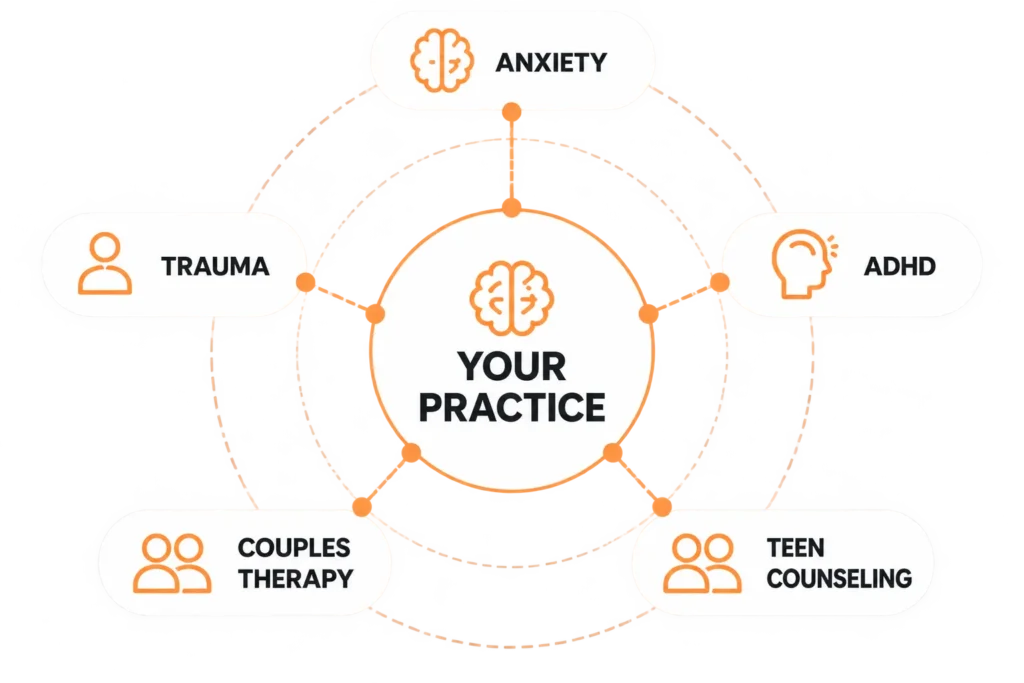
AI systems don’t just match query chunks, they connect meaning. For therapists, that means helping AI understand the relationship between your specialties, conditions, treatment approaches, and the clients you serve.
Instead of creating pages that repeat the same keywords, we build clear topic relationships around your expertise areas such as anxiety, trauma, couples therapy, ADHD, or teen counseling. This helps AI systems understand what you treat, how you help, where you’re located, and who your practice is for.
Build connected content around your core specialties, conditions, and therapy services.
Create sections that clearly explain what you treat, who you help, the area you serve, and the approaches you use.
Build an internal linking strategy & organize related concepts naturally so AI can understand your expertise.
Make key sections clear and self-contained so individual answers can be understood when surfaced independently.
We don’t chase short-term ranking; we’re bigger believers in authority that earns lasting visibility. As a top-rated AI search Optimization agency for therapists, we know how LLMs work to spotlight any therapy. If you’re looking for a ChatGPT AEO agency, Gemini AEO service, or Perplexity AEO optimization for your therapy business, we can make your practice a verified source for AI Search
Book a Free Consultation →AI Search Optimization is the practice of structuring & managing your practice’s online presence so AI tools like ChatGPT, Gemini, Perplexity, Claude and Google AI Overviews recommend you directly when someone searches for a therapist like you.
AEO (Answer Engine Optimization) focuses on getting pulled into short, direct answers. GEO (Generative Engine Optimization) focuses on how you’re described inside longer, generated responses. Most practices need both, which is why we treat them as one strategy.
Yes — directories are part of how AI engines confirm you’re real. AI Search Optimization makes sure your directory presence and your own site work together instead of sending mixed signals.
Traditional SEO gets your page ranked in a results list. AI Search Optimization gets your practice cited inside the one answer a client actually reads.
Yes, if your practice is trusted by AI crawlers. When a practice has consistent, trusted and verifiable information across its website, directories, and in Google Business Profile – AI models starts believing you as an Authority.
Yes. We build citations and reviews without disclosing confidential client information, and we work within the same ethics-board guidelines you already follow for other marketing.
Foundational changes — schema, directory consistency, answer-first content — can produce early citation improvements within weeks, with fuller visibility building over 90 days.
Often more easily than in traditional SEO - AI engines reward specificity and consistency over sheer site size, so a focused, well-structured solo practice site can out-cite a larger, less-organized one.
Yes! The same structured, answer-first content that works for ChatGPT and Perplexity also improves how you show up for spoken queries on Siri and Alexa.